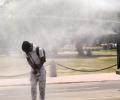
Delhi is experiencing its first heatwave of the season, with temperatures reaching 40.2 degrees Celsius. Doctors have warned that exposure to extreme heat can lead to a range of health issues, from mild rashes and muscle cramps to serious conditions like heat exhaustion and heatstroke. They advise staying hydrated, avoiding outdoor activities during peak hours, and wearing light, breathable clothes. Vulnerable groups like children, the elderly, and those with pre-existing conditions are at greater risk.

Delhi sweltered under intense heat as the Safdarjung observatory, considered the official marker of the national capital, noted a high of 43.8 degrees Celsius, four notches above the normal average.

A Delhi court has reprimanded Tihar Jail authorities for allegedly keeping Christian Michel James, an alleged middleman in the AgustaWestland case, with an inmate who has received 41 punishments for misconduct, raising concerns about Michel's safety. The court also ordered the jail to provide Michel with a table fan, stating that even animals in zoological parks are provided air conditioning. Michel had previously requested to finish his sentence and leave India due to security risks.
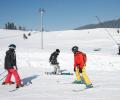
Around 300 athletes were expected to compete in four snow sports -- ski mountaineering, alpine skiing, snowboard, and Nordic skiing -- in the games, which had been due to be held from February 22 to 25.

The weather office said intensity of heat wave/severe heat wave has slightly reduced over some parts of northwest and adjoining central India.

This deterioration in air quality led to prompting enforcement of Stage II of the Graded Response Action Plan (GRAP) in the national capital.

Dr Rituja Ugalmugle, internal medicine specialist, Wockhardt Hospitals, lists the remedies to prevent and fight summer related ailments.

Aprilia did not say if Martin would be fit for the test in Thailand next week or the season-opening Grand Prix at Thailand's Chang International Circuit from Feb. 28.
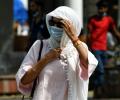
India experienced its second-hottest quarter from June to August this year since 1970, with over one-third of the country's population enduring at least seven days of dangerous heat, according to a new report by a United States-based group of climate scientists and communicators.

Drivers returned to the pits, under a darkening sky, with engineers using torches in the garages before back-up generators came on and the session resumed about an hour later.

According to local authorities, the staff and tourists were in safe condition after the quake, which hit the region at 9:05 am Tuesday (Beijing Time).

Australia heaved a major sigh of relief on Wednesday after skipper Pat Cummins declared run-machine Travis Head fit for the Boxing Day Test against India at the Melbourne Cricket Ground.

Wheat production during the current season is expected to be better than last year provided the weather remains favourable over the next few weeks, said senior industry executives. The weather had turned uncharacteristically hot in the latter half of last month, but owing to strong winds, the chill has returned in the last few days.

Srinagar recorded its third lowest December temperature in 133 years on Saturday.

The weather department also said the national capital recorded only two rainy days this May, the lowest in 10 years.

Himachal Pradesh experienced its second snowfall of the season, leading to the closure of 15 roads, including two national highways. A tourist from New Delhi died in an accident on an icy road in the Lahaul Spiti district, while three others sustained injuries.
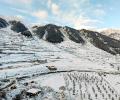
The higher reaches of Kullu and Lahaul and Spiti districts in Himachal Pradesh received intermittent snowfall on Saturday, breaking eight weeks of a dry spell and intensifying the cold wave conditions in the adjoining areas.

The India meteorological department predicted mainly clear skies with heatwave conditions in many parts of Delhi and severe heat wave conditions in other areas.

The Met office has issued a "red" warning for Delhi, Haryana, Punjab and west Rajasthan, stressing the need for "extreme care for vulnerable people".

Leh in Ladakh region recorded the lowest temperature this winter as mercury plummeted to minus 17.1 degree Celsius on Tuesday night, a meteorological department official said.

To ensure immediate cooling of the body, the hospital has set up a first-of-its-kind heatstroke unit.

New Zealand's cricketers are facing a tough test of endurance in the third Test against India in Mumbai on Friday.

Parts of northern and western India reeled under scorching heat with temperatures hovering near the 50 degree-mark in Rajasthan, while the India Meteorological Department said no immediate respite is likely from the ongoing heatwave conditions.
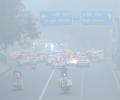
Curbs under Stage III include a ban on non-essential construction and demolition, closure of stone crushers and mining activities in Delhi-National Capital Region (NCR).

The trial incineration of 10 tonnes of waste from the Union Carbide plant in Bhopal, responsible for the 1984 gas tragedy, began on Friday afternoon in Pithampur, Madhya Pradesh. The process, ordered by the Madhya Pradesh High Court, is expected to take 72 hours to complete. The waste includes soil, reactor residues, pesticide residues, and other materials. The State Pollution Control Board says the chemicals in the waste have become "almost negligible" and there is no presence of methyl isocyanate gas. The incineration process is being monitored by the Pollution Control Board and broadcast live.

The all-time low recorded in the month of December in Srinagar is minus 12.8 degrees Celsius on December 13, 1934.

Temperatures remained above 45 degrees Celsius in large parts of Rajasthan, Haryana, Delhi, Chandigarh and Uttar Pradesh, affecting daily life as many chose to remain indoors in the afternoon.

Most parts in north India on Sunday continued to reel under cold wave conditions coupled with fog, with mercury plunging below the freezing point in Rajasthan's sole hill station Mount Abu.

The Mungeshpur weather station recorded a high of 48.8 degrees Celsius, eight notches above the normal. It recorded a minimum temperature of 27.6 degrees Celsius, a notch above the season's average.

Delhiites woke up to a chilly morning with the mercury dipping to 6.8 degree Celsius, a drop of nearly five notches from Saturday when the minimum settled at 11.5 degree.

Leh had on Sunday recorded this season's lowest of minus 18.8 degrees Celsius.

Travelling from South India to Kashmir in December was magical for Ganesh Nadar as he feasted his eyes on the beauty of the snow-capped Himalayas.
Delhiites continued to shiver under severe cold wave conditions as they woke up to a foggy morning on Friday with the minimum temperature plunging below 5 degree Celsius.

Ten to 20 days of heatwave are expected against the normal of four to eight days in the entire April-June period.
Maximum temperature at around 8 am on Monday was 18.1 degree Celsius, three degree Celsius below normal. On Sunday it was 18.7 degree Celsius.

The threshold for a heat wave is met when the maximum temperature of a weather station reaches at least 40 degrees Celsius in the plains, 37 degrees in coastal areas, and 30 degrees in hilly regions, and the departure from normal is at least 4.5 notches.
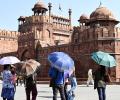
'The intensity and frequency of heatwaves will be much higher than in previous years over Punjab, Haryana, Rajasthan, Gujarat, Madhya Pradesh and Odisha.'

In the national capital, the maximum temperature was recorded at the season's highest at 44 degree Celsius.
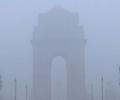
The India Meteorological Department (IMD) reported that very dense fog began forming around 5.30 am, resulting in a thick haze over different parts of the national capital.

The searing heat pushed the city's peak power demand to its highest for May, while the Delhi government directed the schools that have not closed for summer vacations to do so with immediate effect.
